
Seeing Beyond a Single Point of View
Pastors and ministry leaders know Greater Austin through lived experience. They know a congregation, a neighborhood, a school, a workplace, or a community from the inside. That knowledge is real and necessary, but no single experience can represent a metropolitan area this large and varied.
The Society studies the people, places, congregations, ministries, and cultural realities of Greater Austin so leaders can pray and act. Research is not the mission, and data does not replace discernment. It is one form of listening to people and place.
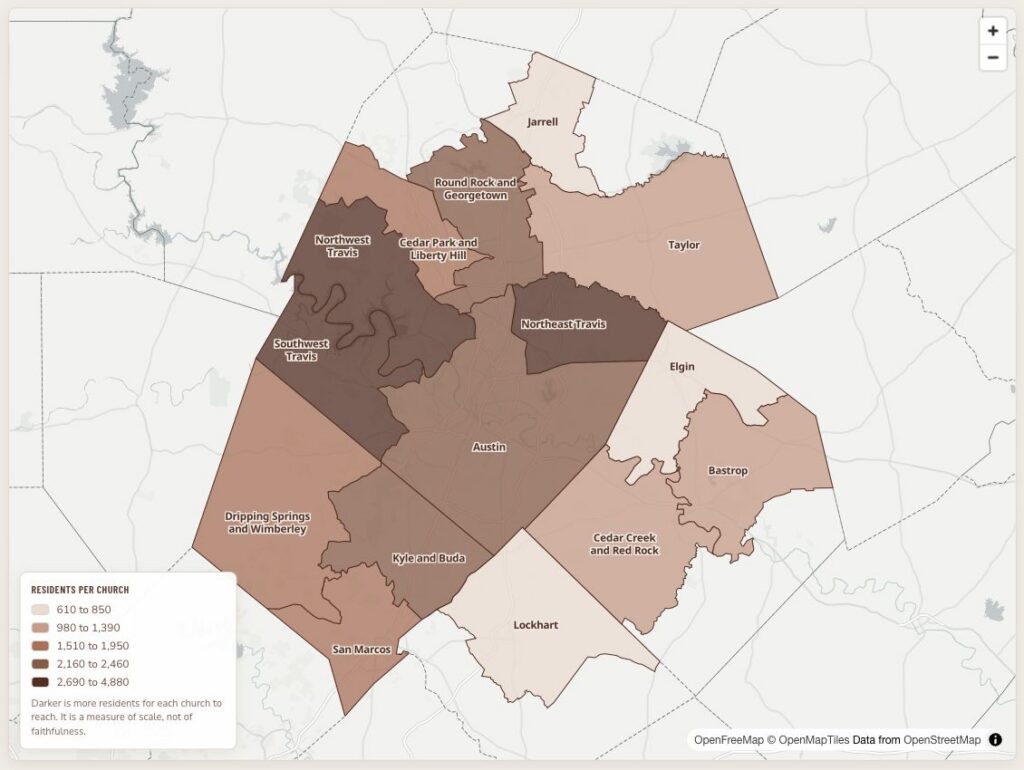
Greater Austin’s fifteen Census County Divisions, shaded by residents per active congregation. Darker areas have more residents per active congregation; the figure measures relative scale, not a congregation’s reach or faithfulness. Static capture from the Society’s State of the City Data property, August 27, 2026.
What We Are Building
A Map of Greater Austin’s Congregations
The Society is documenting active congregations across Greater Austin, including churches worshiping in languages other than English. The map helps leaders see distribution, tradition, language, and the places where the Church may be stretched.
The current Society church database documents more than 1,200 active congregations across Greater Austin. More than 200 congregations worship in languages other than English, including Spanish, Korean, Mandarin, and Portuguese.
A Wider View of Christian Ministry
The Society has reviewed ministry and nonprofit websites as one input into understanding who is serving, where work is concentrated, and which needs may receive less attention. A website review cannot establish the full life, quality, or fruit of a ministry, but it can help identify patterns and questions worth pursuing in relationship.
More than 1,200 ministry websites reviewed; Greater Austin Mission Society 2025 annual report.
Regional Profiles
Greater Austin is not one uniform mission field. The Society organizes research across fifteen divisions so leaders can see the people, churches, and conditions near them while keeping the wider region in view.
The State of the City
The State of the City brings data and interpretation together for leaders across Greater Austin. Formal reports provide a dated picture; the Data property continues to develop between editions.
Oral Histories
Data can show change, but it cannot preserve the full memory of the Church in this place. The Society hopes to record stories from pastors, missionaries, congregations, ministries, and disciples whose faithfulness has shaped Greater Austin.
How We Hold the Numbers
Some findings are directly verifiable, including locations and public statements. Others are estimates drawn from Census data, surveys, and stated assumptions. The Society identifies the difference and explains the limits of each measure.
The Society would rather offer a number with its limits attached than a confident figure that cannot carry weight. When better information reaches us, the work changes.
Detailed methodology, sources, geography, classification standards, privacy practices, and correction processes belong on the Data property, where they can remain close to the evidence they govern.
What Research Can and Cannot Do
Research can help the Church ask better questions, notice patterns, test assumptions, and bring different local experiences into one conversation. It can show where evidence is strong, where it remains partial, and where correction is needed.
Research cannot measure the movement of the Holy Spirit, describe the full life of the Church, or define the kingdom of God. Wisdom still requires prayer, relationship, Scripture, and discernment.
“By wisdom a house is built, and by understanding it is established; by knowledge the rooms are filled with all precious and pleasant riches. A wise man is full of strength, and a man of knowledge enhances his might, for by wise guidance you can wage your war, and in abundance of counselors there is victory.”
Proverbs 24:3–6 (ESV)
Let the Evidence Lead to Better Questions
Research does not determine the Church’s response. It helps leaders bring the city they are actually serving into prayer, relationship, and shared discernment.
Connect. See clearly. Act together.