
An Old Form for a New Missionary Moment
A mission society is a voluntary association of Christians who organize around shared mission beyond the responsibility of one congregation. It does not replace the local church. It gives people from different churches and ministries a durable way to pray, learn, coordinate, and carry work together.
The form is old, but the local need is newly urgent. Greater Austin is growing, changing, and becoming less shaped by practiced Christian faith. Many organizations serve the Church nationally or internationally, and many local networks create valuable relationship and learning. Fewer institutions are built to hold local research, relationships, coordination, and shared responsibility together over time. Greater Austin Mission Society is a faithful experiment in what such a locally rooted society might make possible here.
Where the Name Comes From
Mission societies have helped Christians work across church boundaries for centuries. The Moravians sustained prayer and sent ordinary tradespeople across cultures. The London Missionary Society gathered Christians from several Protestant traditions. The Church Mission Society organized voluntary participation in mission. The China Inland Mission sent workers to live among the people they served.
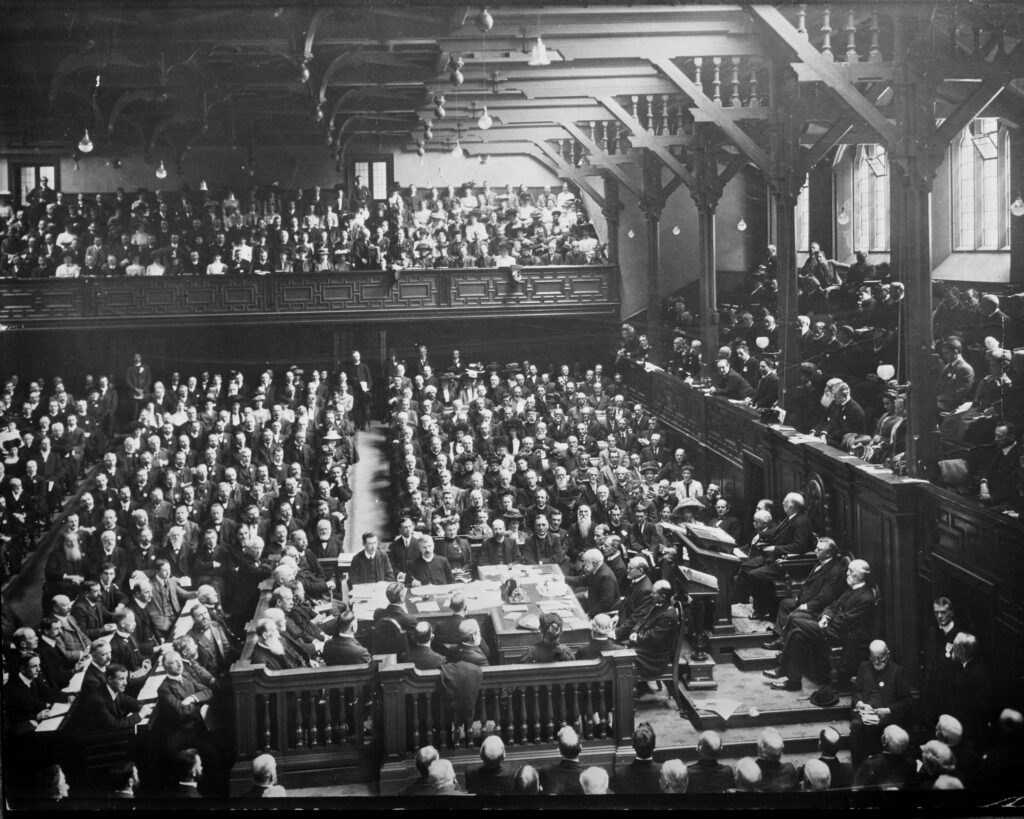

These societies differed in tradition, organization, place, and method. What they shared was a voluntary way for Christians to pray, organize, send, learn, and sustain mission beyond the responsibility of one congregation. Greater Austin Mission Society does not claim their institutional lineage. It receives the older name as a reminder that shared mission often needs a form sturdy enough to carry it.
Sources and further reading
For historical context, see the Moravian Church Board of World Mission history; the SOAS University of London missionary collections, including the London Missionary Society archive; Church Mission Society’s history; and OMF International’s history of the China Inland Mission.
How the Society Fits
Local Church
Shepherds a congregation, makes disciples, administers its common life, and bears witness in a particular community.
Denomination
Joins churches through shared doctrine, governance, accountability, and mutual responsibility.
Mission Agency or Christian Nonprofit
Organizes people and resources around a defined field, issue, people, service, or sending responsibility.
Network
Creates relationship, affiliation, learning, mobilization, or exchange among people and organizations.
Local Mission Society
Builds durable voluntary capacity for Christians across churches and ministries to pursue shared mission in one place.
Why This Serves Austin
Greater Austin is one metropolitan area, but it is not one uniform community. Churches and ministries serve different neighborhoods, counties, cultures, generations, and callings. No organization can see the whole place from one point of view, and no organization should carry the whole mission.
A local mission society can hold relationship, research, prayer, coordination, and follow-through together over time. It can also provide a common banner and supportive platform for apostolic, prophetic, evangelistic, and other missionary leaders whose callings do not fit neatly inside one traditional structure.
The Society seeks to be a container for that shared life, a catalyst that lowers the barriers to useful cooperation, and a convener when bringing people together can help the Church address a real missionary gap. Participation remains voluntary. Churches and ministries keep their own authority and calling, while people choose to share knowledge, build trust, and carry defined responsibility with others.
The Society is not the city’s movement or its controlling center. It is one locally rooted institution seeking to strengthen the connections through which the Church can listen and act together.
People Choosing to Carry Something Together
A society exists because people and organizations choose to participate. They keep their own callings and responsibilities. They also choose to show up, pray, share what they know, tell the truth about the city, discern what responsibility is actually shared, and carry the part they have agreed to carry.
The Society serves that voluntary work by making connections, developing common understanding, and supporting follow-through. It cannot manufacture unity. It can make room for people to practice it.