
We Long to See God’s Kingdom Come in Greater Austin
We pray for God’s kingdom to come and His will to be done in Greater Austin: the gospel of Jesus shared, people reconciled to God and one another, the Church living visibly as one body, and the life of the city marked more deeply by truth, mercy, justice, generosity, holiness, and hope.
We also pray for a flourishing ecosystem of congregations, ministries, institutions, leaders, and disciples—distinct parts of Christ’s body rooted in their places, alive to their callings, and able to carry shared responsibility.
Over ten years, we hope a greater share of our neighbors are practicing Christians and churches are planted and sustained at least as fast as the region is growing. These are not outcomes the Society can produce or claim. God gives the growth. Our responsibility is to serve faithfully, tell the truth about what we can see, and help the Church act with wisdom, courage, and humility.
The goal is not a larger organization. It is more neighbors following Jesus, more of God’s kingdom expressed in the life of the city, and a more faithful and flourishing Church serving every part of Greater Austin.
What We Hope Becomes More True
More People Following Jesus
More neighbors hear the gospel, trust Christ, worship with His people, and learn obedience in the whole of life.
God’s Kingdom Expressed
Disciples and churches pursue reconciliation, mercy, justice, generosity, holiness, truth, and faithful presence.
Churches and Leaders Multiplying
Churches are planted and strengthened, disciples are formed, and leaders are recognized, supported, and entrusted.
A Flourishing Ecosystem
The Church’s different parts are healthy, connected, and able to respond when shared responsibility is needed.
No single measure can describe the city we pray for. These forms of fruit belong together.
One Church. Seven Lanes of Shared Mission.
A flourishing ecosystem is not one organization directing the whole. It is the Church’s different parts faithful to their callings, connected strongly enough to cooperate, and able to move people and resources toward shared gaps. These seven lanes are common vocabulary—not Society departments, a ranking, or a finished assessment.
One Church
The Church across Greater Austin is one body in Christ. Congregations remain central, while disciples, ministries, institutions, networks, funders, and leaders carry distinct responsibilities within its shared witness.
Church Planting and Renewal
New and renewed churches strengthen faithful witness across the region.
Intercessory Prayer
Durable prayer helps the Church seek God together for Greater Austin.
Evangelism and Disciple-Making
Disciples share the gospel, follow Jesus, and help others obey Him.
Mercy and Justice
Churches pursue their neighbors’ good through compassion, righteousness, and durable service.
Faith and Work
Christians follow Jesus in workplaces, professions, institutions, and public life.
Christian Institutions
Schools, nonprofits, and ministries serve the Church and city with integrity.
Leadership Development
Leaders are recognized, formed, supported, and entrusted across the Church.
Current qualitative work points especially to intercessory prayer, evangelism and disciple-making, and leadership development. This is a working discernment, not a permanent verdict. Better evidence, wider relationships, and prayerful correction should change it when attention belongs elsewhere.
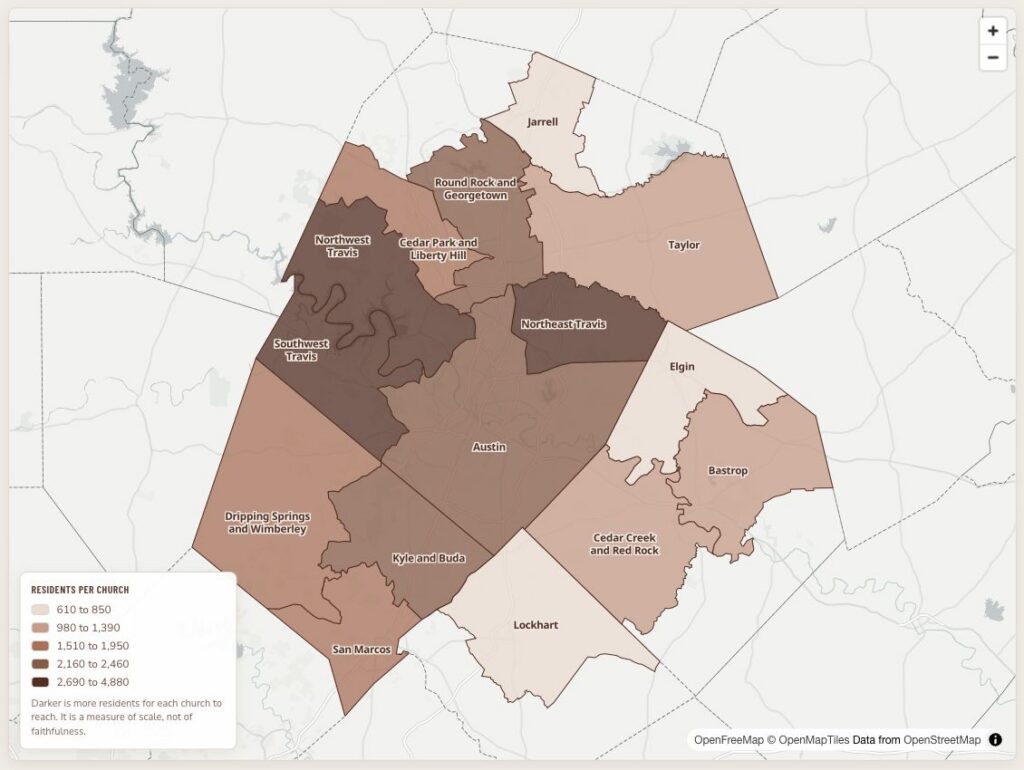
Fifteen Places Across Greater Austin
Greater Austin is one region, but it is not one place. People experience it through distinct communities, histories, relationships, and ministry conditions.
The Society uses the region’s fifteen Census County Divisions as one stable way to ask where people live, where congregations are present, and where the distance between them is growing. The divisions do not replace neighborhoods or local knowledge. They give leaders a shared geographic frame for prayer, research, and coordinated action.
Connect. See Clearly. Act Together.
Relationships create the trust that shared work requires. When a particular gap calls for coordinated action, a fuller discipline helps independent churches and organizations pursue a common outcome without becoming one organization or all doing the same thing.

Connect
Build trusted relationships, help people carrying related responsibilities find one another, and maintain honest communication.

See Clearly
Name the problem and desired outcome together. Bring research, local knowledge, prayer, and lived experience into a shared view, then agree on a few indicators of progress.

Act Together
Let each church, ministry, leader, or institution contribute from its own calling and strengths while aligning those contributions toward the shared outcome.
Steady Coordination
Shared work needs someone to hold the relationships, information, measures, communication, and follow-through. The Society may provide or share that coordination without owning every response or directing every participant.
Then the partners ask what changed, share what they learned, adapt the work, and begin again. Collaboration is not the goal. Faithful kingdom fruit is.
How We Will Recognize Meaningful Fruit
Measurement cannot prove where God is at work, and no citywide trend belongs to the Society. It can help the Church notice change, correct assumptions, and learn together.
Regional Gospel and Kingdom Signals
We hope the share of practicing Christians increases and church planting keeps pace with or exceeds population growth. These are meaningful signals, not the whole vision.
Ecosystem and Lane Health
Within each shared lane, leaders can identify one durable measure worth following over time. Across the whole ecosystem, we also look for wider trust, stronger ministry capacity, clearer paths into service, named responsibility for gaps, and information and resources moving toward needed work.
Shared-Initiative Outcomes
Each collaborative effort should name its common agenda, shared measures, ownership, and intended results for particular people or places.
A practicing-Christian measure requires a stable source and repeatable definition. Church-planting pace should be read as new congregations per 100,000 residents alongside residents per active church and known closures. The people carrying each effort should own its claims; the Society should state its contribution without claiming sole causation.
Shared church-planting leadership, formation interviews, a practitioner cohort, and pilot trainings are current places to build trust, align contributions, measure what can be known, and learn what should happen next.
Sources and Definitions
This Page brings together the Society’s vision, its Fall 2025 qualitative gap analysis, conversations with Greater Austin leaders, the seven-lane ministry frame, the Society’s team-based-work presentation, Todd Engstrom’s August 28, 2026 direction, and current State of the City methods.
The fuller shared-work discipline draws from the Collective Impact framework introduced by John Kania and Mark Kramer. Its five conditions are a common agenda, shared measurement, mutually reinforcing activities, continuous communication, and dedicated coordinating support. The original literature commonly calls the final condition a backbone support organization. The Society uses plain language because the function matters more than the label, the role may be shared, and no organization should assume it directs the Church.
Collective Impact is useful for a defined issue and shared outcome. It does not describe every relationship or network. Healthy networks build trust, shared language, learning, and distributed leadership before a specific collective effort begins.
The practicing-Christian outcome is a proposed longitudinal measure, not a current trend claim. A baseline requires a repeatable source, geography, definition, and comparison method. The State of the City planting measure counts new congregations per 100,000 residents in comparable five-year windows and should be interpreted with its published limits.
The seven-lane frame and current priorities are qualitative working models. They invite testing and correction; they do not score congregations, declare where the Spirit is moving, or replace prayer and pastoral judgment.
Bring Your Place Into the Picture
Pastors, disciples, ministry leaders, researchers, funders, and neighbors each see something the rest of the Church may need. If you carry responsibility for a people, place, or part of the mission, the Society would be glad to learn from what you are seeing.